


Annual AML/CFT Risk Assessment Report
The annual AML/CFT risk assessment survey is an online form that the Ministry of Economy and Tourism asks the businesses it supervises to fill in and submit once a year. It asks about your customers, your products and services, the countries you deal with, how you take on new business, and the controls you run. The Ministry uses the answers to build a picture of money laundering and terrorism financing risk across each sector.
This is not the same document as the ML/FT risk assessment you prepare for your own business as a part of the AML/CFT/CPF programme, and confusing the two is the most common mistake we see. We prepare the MoET annual AML/CFT risk assessment survey submission for you, using your own records, and we make sure your answers match what your own risk assessment already says.

Key facts at a glance
Five things to know before you read further: who files, what it is, when it is due, what it is not, and who signs it off.
- Who has to file: businesses supervised by the Ministry of Economy and Tourism. In practice, that means dealers in precious metals and stones, real estate agents and brokers, company and trust service providers, and independent accountants and auditors.
- What it is: an online questionnaire on the Ministry’s Risk Assessment Portal, also called the AML survey, the AML/CFT questionnaire, the ML/TF risk assessment data collection exercise, the AML/CFT questionnaire, or the ML/TF risk assessment data collection exercise or simply the MoET survey.
- When it is due: reporting opens in January, after the Ministry’s notice, and the window normally stays open for about 30 days. The MoET sets the exact date in each notice, so do not assume it. See the current cycle block below for each cycle. Deadlines have been extended in past cycles, so always check the Ministry’s current notice for this year’s date.
- What it is not: it is not your enterprise-wide risk assessment, and submitting it does not discharge that separate obligation.
- Who signs it off: your compliance officer normally prepares it, and senior management should review the answers before submission.
Current MoET AML/CFT Risk Assessment Survey Cycle
This block holds the live dates. We update it each time the Ministry of Economy and Tourism issues a notice. Everything below it on this page is evergreen. If the two ever disagree, this block wins.
- Which reporting period does the current survey cover?
The next survey covers the year ending 31 December 2026. Reporting opens in January 2027, after the Ministry issues its notice. The survey always looks back at the financial year that has just closed, so the figures you report are last year’s, not this year’s to date.
- What is the current submission deadline?
No date is set until the Ministry issues its notice. The window then normally stays open for about 30 days, so the deadline for the year ending 31 December 2026 will most likely fall in late January or February 2027. Treat that as a planning assumption, not a date, and confirm it from the notice when it arrives.
- Has the Ministry extended the deadline?
Extensions have been granted in past cycles, sometimes more than once in the same cycle. Do not build your process around one. If an extension comes, treat it as unplanned breathing room.
- Where is the current survey submitted?
The Ministry’s Risk Assessment Portal at https://amlquestionnaire.moec.gov.ae/#/login. Follow the access instructions in your latest notice, because credentials and process can change between cycles even when the address does not.
What Is the Annual AML/CFT Risk Assessment Survey? (MoET Risk Assessment Data Collection)
It is a data collection exercise. Once a year, the Ministry of Economy and Tourism opens an online form and asks each business it supervises to report facts about its customers, its services, the countries it deals with, the way it onboards clients, its transaction volumes, and the AML controls it has in place. You log in, answer the questions, and submit before the deadline.
The Ministry is not marking your homework on a single form. It adds your answers to everyone else’s so it can see where risk sits across a whole sector, which feeds national policy and helps decide where supervisors spend their inspection time. That is why the questions are mostly factual and quantitative rather than open-ended.
You will see the exercise called several different things, and they all mean the same submission: the AML survey, the AML/CFT questionnaire, the AML risk assessment questionnaire, the ML/TF risk assessment data collection process, or simply the annual return. If a Ministry notice or a consultant uses any of those phrases, they are referring to this form.
MoET AML Survey vs EWRA vs goAML Registration
These are three different obligations. The MoET survey is a supervisory questionnaire you send to the Ministry. Your EWRA is your own documented assessment of your ML, TF and PF exposure. goAML is the reporting platform you register on to file suspicious transaction reports. None of the three replaces either of the others. The survey is the Ministry’s form, on the Ministry’s deadline, for the Ministry’s purposes. Your own risk assessment, often called the enterprise-wide risk assessment or EWRA or BRA, is your document, based on your own methodology, and it is what your policies and controls must be built on. Submitting the survey does not discharge your own assessment, and having a good assessment does not mean the survey is filed.
People confuse them because all three carry the words risk or reporting, and all three are annual or ongoing. Here is the difference on the points that matter.
| The question | The MoET AML survey | Your own risk assessment | goAML registration and reporting |
|---|---|---|---|
| Who runs it? | The Ministry of Economy and Tourism | You can do it yourself or we can help you with your EWRA | You can do it yourself or we can help you with goAML registration |
| Whose format? | The Ministry's online form and its fixed questions | Your own methodology, risk factors and scoring | The goAML portal and its fixed report types |
| Who is it for? | The Ministry, to build a picture of sector risk | Your senior management, your auditor and your supervisor to identify, assess, and deploy controls to mitigate your ML/TF/PF risks. | The FIU, for suspicious transactions and other required reports |
| What creates the duty? | The Ministry's own notice, issued under its supervisory powers | Federal Decree-Law No. 10 of 2025, Article 19(1)(a), and Cabinet Resolution No. 134 of 2025, Article 5 | Federal Decree-Law No. 10 of 2025, Article 18 |
| How often? | Once a year. Opens in January on notice, then about 30 days | Kept up to date on an ongoing basis, refreshed at least yearly | Continuous. You register once, then report when an event happens |
Who Must Submit the AML/CFT Risk Assessment Survey in the UAE?
Every business that the Ministry of Economy and Tourism supervises for AML purposes. That is four groups:
- Dealers in precious metals and stones. Jewellers, refineries, gold traders and bullion dealers.
- Real estate agents and brokers. Firms that broker sales and purchases of property.
- Company and trust service providers. Firms that set up or administer companies and trusts for clients.
- Independent accountants and auditors. Firms that prepare for or carry out specified financial transactions for clients.
Two points of confusion worth clearing up. First, lawyers and notaries are also designated businesses, but they are supervised by the Ministry of Justice rather than the Ministry of Economy and Tourism, so their reporting route is different. Any filing of this kind would come from a notice issued by their own supervisor, and the obligation to prepare and maintain their own risk assessment applies either way. Second, banks, exchange houses, insurers, capital market firms, and virtual asset firms are supervised by the Central Bank, the Capital Market Authority or VARA, and they file their own separate returns. Those are covered further down this page.
Size does not exempt you. A single office with one compliance officer still has to submit, and the answers are simply shorter than a large firm’s. If you hold a licence in a covered activity and the Ministry supervises you, the form applies.
Not sure if this survey is yours to file?
We confirm your scope in one call.
What the AML Questionnaire Asks
The form asks for facts about your business, not opinions. The exact question set is revised from cycle to cycle, so treat the list below as the shape of it rather than a field-by-field guide, and read the current form before you start. Broadly, expect questions in six areas:
Your customers
How many you have, what types they are, how many are companies rather than individuals, how many are based outside the UAE, and whether any are politically exposed persons.
Your products and services
Which of your activities fall inside the AML rules, and the size and number of transactions running through them.
Your geographies
The countries your customers, counterparties and payments come from and go to, and your exposure to countries on the high-risk lists.
Your delivery channels
Whether you onboard face-to-face or remotely, and whether you use agents, introducers or intermediaries.
Your volumes and values
Transaction counts and amounts for the reporting period, usually in dirhams, and how much of it is cash.
Your controls and governance
Whether you have a compliance officer, a written policy, a risk assessment, training records, screening arrangements, and how many suspicious transaction reports you filed.
Almost every one of those answers should already exist in your own records. If you have a current risk assessment, the customer, product, geography and channel questions are a lookup rather than a research project. If you don’t, you’ll estimate under deadline pressure, and those estimates will sit on the Ministry’s file with your name on them.
What the Survey Asks Your Sector
The core form is the same for everyone. What differs is which answers take the work, and how many questions you end up seeing.
On size: last cycle the form ran to more than 300 questions. The exact number depends on your sector, the nature of your business and your own circumstances, because the form branches. Answer yes to one question and several more open up. So a count you read on another website is that firm’s count for one sector in one cycle, not yours. Below is where each sector spends its time.
MoET AML survey for dealers in precious metals and stones (DPMS)
Cash is the pressure point. Expect to report your cash proportion, transactions at or above the reporting threshold, walk-in and one-off customers, buy and sell turnover, and where your stock comes from. Have your cash records reconciled before you start.
MoET AML survey for real estate agents and brokers (REAB)
Buyer profile does the work here. Expect questions on buyer and seller counts, non-resident purchasers, payments made by someone other than the buyer, and layered or corporate ownership. Your real estate activity report filings sit alongside these answers, so keep them consistent.
MoET AML survey for trust and company service providers (TCSP)
Ownership opacity is the theme. Expect to report the number and type of structures you administer, nominee director and shareholder arrangements, how deep your beneficial owner chains run, and how many clients sit outside the UAE.
MoET AML survey for independent accountants and auditors (IAA)
Scope is the hard part. Expect to state which engagements fall inside the covered activities, how you triage new work, whether you hold client money, and how engagement acceptance works as a control. Firms often over-report here by counting out-of-scope work.
What Documents and Data Do You Need Before You Start?
Ten things. Your trade licence and ownership records, your customer register, your due diligence and screening files, your politically exposed person records, your country exposure data, your transaction counts and values, your cash figures, your suspicious transaction report count, your policy and training records, and last cycle’s submission. Gather those, and the form becomes a transcription job. Miss them, and it becomes a week of guessing. The table below maps each survey answer to its source record.
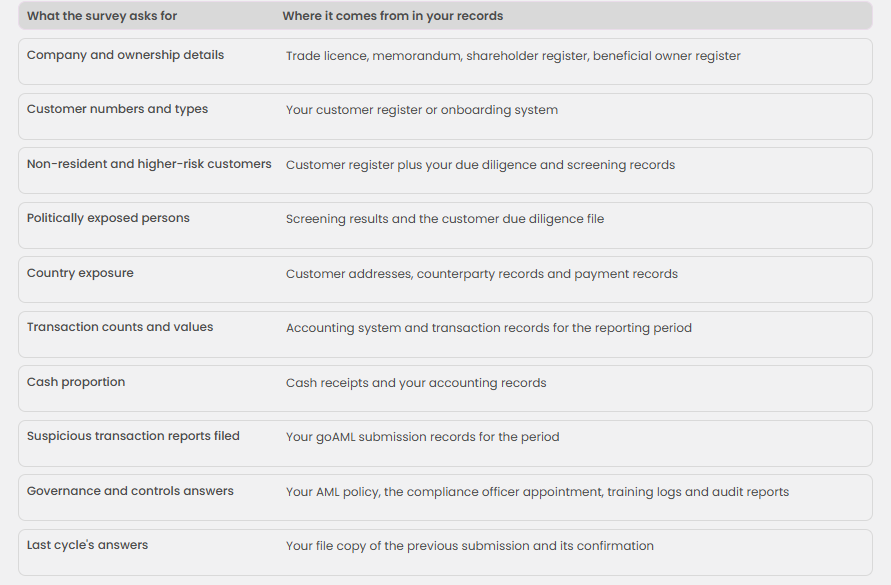
What the survey asks for
Where it comes from in your records
Company and ownership details
Trade licence, memorandum, shareholder register, beneficial owner register
Customer numbers and types
Your customer register or onboarding system
Non-resident and higher-risk customers
Customer register plus your due diligence and screening records
Politically exposed persons
Screening results and the customer due diligence file
Country exposure
Customer addresses, counterparty records and payment records
Transaction counts and values
Accounting system and transaction records for the reporting period
Cash proportion
Cash receipts and your accounting records
Suspicious transaction reports filed
Your goAML submission records for the period
Governance and controls answers
Your AML policy, the compliance officer appointment, training logs and audit reports
Last cycle's answers
Your file copy of the previous submission and its confirmation
MoET AML Questionnaire Login and Risk Assessment Portal
Where do I log in to the MoET AML questionnaire?
You log in at the Ministry’s Risk Assessment Portal:
https://amlquestionnaire.moec.gov.ae/#/login. That address has stayed the same across cycles, so bookmark it. What changes each cycle is your access. The Ministry issues the survey notice with the credentials or registration route for that round, and the process can change between cycles. Always follow the access instructions in your latest notice.
Your access details matter, and they arrive with the notice. If that notice goes to a staff member who has left, or to an address nobody checks, you may not hear about the survey until after the deadline. Keep the contact details registered against your licence current, and make sure more than one person sees anything that arrives from the Ministry.
The annual AML/CFT risk assessment survey submission process runs roughly like this:
1. Watch for the notice
Confirm that the contact details held against your licence are current, and that whoever receives Ministry correspondence knows to flag it immediately.
2. Download or open the current form
Read the whole thing before answering anything, so you know what data you will need to pull.
3. Pull your numbers for the reporting period
Customer counts, transaction volumes and values, country exposure, and your suspicious transaction report count.
4. Draft the answers against your own records
Use your risk assessment, your customer register, and your transaction reports as the source, not memory.
5. Have senior management review before you submit
Once it is filed, it is on the record, and it should say the same thing your own documents say.
6. Submit, then save the evidence
Keep the confirmation, a copy of the answers, and the date. A supervisor may ask you to produce them.
One more habit worth building: keep a short file for each cycle holding the notice, your access details, the completed answers, the submission confirmation and the date. It takes minutes, and it is what you produce if a supervisor asks what you told the Ministry and when.
What if you did not receive the survey link?
Contact the MoET here: https://www.moet.gov.ae/en/contactus and ask for it. Don’t wait for the deadline to pass, and don’t assume the survey doesn’t apply to you because nothing arrived. The usual cause is a stale contact address held against your licence, so fix that at the same time.
What if the questionnaire shows the wrong sector?
Stop and raise it before you answer. A form issued for the wrong sector asks the wrong questions, and answering it anyway puts inaccurate data on your record. Contact the Ministry, explain your licensed activity, and ask for the correct form.
Annual AML/CFT Survey Deadline and Extensions
Reporting opens in January, after the Ministry issues its notice, and covers the just-closed financial year. The window then normally stays open for about 30 days. So the deadline is not a fixed calendar date. It depends on when the notice goes out. The Ministry has extended the deadline in past cycles, sometimes more than once in the same cycle, so the date you were given in December may not be the one that applies. Check the Ministry’s current notice rather than relying on last year’s calendar.
Two practical consequences. First, do not treat an extension as the plan. Firms that build their process around the extended date get caught when it doesn’t come. Second, the window opens in the same weeks as your year-end close and audit requests. Pull your survey data in December, before the notice arrives, and January becomes transcription rather than a scramble.
Outside the annual cycle, four things should make you revisit what you told the Ministry: a new product or service, a new market or delivery channel, a material change in your customer base or volumes, and any inspection or audit finding. If your business has changed materially since you filed, your next submission needs to show it.
The notice lands in January. The window is short.
We prepare and file the whole submission.
How to Prepare Your Survey Answers From Your Own Records
Answer the survey from documents, not from memory. Every firm that finds this exercise painful is doing it the same way: someone opens the form in the last week of January and starts estimating. Every firm that finds it easy is reading numbers off records it already keeps.
The four sources that do most of the work:
- Your customer register. Gives you customer counts, the split between individuals and companies, how many are based outside the UAE, and any politically exposed persons you have flagged.
- Your own risk assessment. Gives you the geography, product, and delivery-channel picture, already analysed. If it is current, most of the survey is a lookup.
- Your transaction records. Give you volumes, values and the cash proportion for the reporting period.
- Your compliance file. Gives you the policy date, training records, screening arrangements, and your suspicious transaction report count.
Then do one thing most firms skip: read your draft answers against your own risk assessment before you submit. If the survey says most of your customers are low risk and your own assessment says your largest exposure is high risk non-resident buyers, you have handed the Ministry a contradiction with your name on it. Supervisors do compare the two, and an inconsistency is a much worse start to an inspection than an uncomfortable number honestly reported.
If you do not have a current risk assessment, the survey will expose that quickly, because the questions assume one exists. Building the assessment first and filing the survey from it is the right order, and it is cheaper than doing both under deadline pressure. Our business risk assessment service covers the assessment; we then use it as the source for your submission.
What Happens After You Submit the Survey?
Submission is not the end of the cycle. Three things can follow, and you should be ready for all three.
Keep the confirmation and a copy of the answers
Save the submission confirmation, the completed answers and the date in one file. This is what you hand over if a supervisor asks what you told the Ministry. Without it, you are reconstructing your own submission from memory.
If the Ministry asks for clarification
Answer from the same records you used for the original submission, not from a fresh estimate. A clarification that contradicts your first answer is worse than the original gap. Keep the correspondence with your cycle file.
If a response is returned for resubmission
Fix the specific point raised and resubmit within the given window. Then check whether the same error appears elsewhere in your answers, because a single flagged field often reflects a data problem that affects several.
How long to keep it
Keep each cycle’s file for as long as you keep your other AML records. Record keeping and prompt retrieval are a legal requirement in their own right [Cabinet Resolution No. 134 of 2025, Article 25], and a supervisor may ask for several years of submissions at once.
What Happens If You File Late, Incompletely or Inconsistently
There are three separate risks here, and they are not equally understood.
Missing the deadline
This is a supervisory failure on your record. It is also the most avoidable, and it almost always happens because the notice goes to the wrong person rather than because anyone decides not to file.
Filing incomplete or estimated answers
Numbers you invented under time pressure stay on the Ministry’s file. If a later inspection produces different figures from your own systems, you are explaining the gap rather than discussing the risk.
Filing answers that contradict your own documents.
The most damaging of the three, and the least talked about. It suggests either that your records are unreliable or that you completed the survey without reference to them.
Late submission, inconsistency, or failure to file the annual AML/CFT risk assessment can result into a warning, a fine of not less than AED 10,000 and not more than AED 5,000,000 per violation, a sector bar, restriction or suspension of the responsible people, suspension of the activity, licence revocation, publication of the penalty, and an increased fine on recurrence within a year under Article 17(3).
Annual AML Returns Required by Other UAE Regulators
If the Ministry of Economy and Tourism is not your supervisor, this page is not your filing. Most UAE regulators run their own annual return, and they differ in name, form and deadline. Here is where each one sits, so you can go straight to the right guide.
Your supervisor
What you file
Where to read more
Ministry of Economy and Tourism
The annual AML/CFT risk assessment survey, covered on this page. Reporting opens in January on notice and normally runs about 30 days.
This page
DFSA (DIFC)
Annual AML Return, submitted through the DFSA ePortal. AML Rule 14.5.1 decides whether your firm is in scope.
Annual AML Return for DFSA
FSRA (ADGM)
Annual AML Return under AML Rulebook Rule 4.6. It covers 1 January to 31 December of the preceding year, and the form was updated in 2025.
A Comprehensive AML Guide for ADGM Companies
Central Bank (CBUAE)
An Annual Declaration signed jointly by the chief executive and the chairman of the board, or by the owner of a sole establishment, on or before 31 January each financial year. There is also a bi-annual compliance report.
CBUAE Rulebook, Article 25
Capital Market Authority (CMA)
An annual AML/CFT and targeted financial sanctions risk assessment return, plus a semi-annual AML/CFT report.
AML Regulations for CMA-Regulated Market Institutions and Brokers
VARA
Not a filing. Your MLRO reports to the board every quarter on how well your AML controls work, and VARA can ask for a copy of those reports at any time.
VARA Compliance and Risk Management Rulebook
Ministry of Justice
Legal professionals are supervised by the Ministry of Justice. Follow any notice issued by that ministry.
This page, for context
Different regulator? We still file it.
Tell us your licence, get a scope and a quote.
What Our MoET AML Survey Submission Service Includes
Survey preparation, data validation, reconciliation against your own risk assessment, and filing support. Reconciliation is the part most providers skip, and it stops your submission from contradicting your own records.
Filing-scope confirmation. We check your licence and covered activities and confirm whether the Ministry’s survey is yours to file.
Data request and evidence collection. You get one precise list of what we need, not a series of follow-up emails.
Questionnaire preparation. We draft every answer from your records and flag anything your records cannot support.
Reconciliation with your risk assessment. We read your draft answers against your own assessment and resolve every disagreement before filing.
Management review pack. A short summary your senior management can approve without reading the whole form.
Submission and evidence retention. We file, then hand you the cycle file: notice, answers, confirmation and date.
Clarification and resubmission support. If the Ministry comes back, we answer from the same records, not from a fresh guess.
Who Prepares Your AML/CFT Risk Assessment Survey Submission?
Your compliance officer can do it, and an external firm can do it for you. Either way, the answers are your firm’s answers and the accountability stays with you, so the question is really about who has the records, the time and the judgement in January.
Firms usually bring us in for one of three reasons: they have no current risk assessment to answer from, they have one, but nobody is confident the survey answers will match it, or the notice arrived, and the deadline is too close to do it properly in-house. If you are choosing a provider, three questions separate them:
- Will you answer from our records, or ask us to describe our business? If the answers come from a conversation rather than from data, they will not survive comparison with your own files.
- Will you reconcile the submission against our own risk assessment? This check prevents the most damaging kind of error, and it is the one most often skipped.
- Will we be able to do it ourselves next year? A good engagement leaves you with a repeatable process and a data list, not a dependency.
We have delivered over 1,500 annual AML/CFT risk assessment surveys, which is where our sector benchmarks and our data checklists come from.
The Specialists Who Prepare Your Submission
CAMS-certified specialists prepare the submission and file these forms every cycle across all four Ministry-supervised sectors.

Pathik Shah
CAMS, FCA, CS, CISA, DISA (ICAI), FAFP (ICAI)
Experience
28+ years
Regulatory Coverage
MoET, MoJ, CBUAE, CMA, FSRA, DFSA, VARA · AML/CFT framework design, RegTech

Jyoti Maheshwari
CAMS, ACA
Experience
11+ years
Regulatory Coverage
MoET, MoJ, CBUAE, CMA, FSRA, DFSA, VARA · AML/CFT/CPF framework, health checks

Dipali Vora
CAMS, ACS
Experience
10+ years
Regulatory Coverage
MoET, MoJ, CBUAE, CMA, FSRA, DFSA, VARA · Consulting, training, implementation

Monika Shah
CAMS
Experience
3+ years
Regulatory Coverage
MoET, MoJ, CBUAE, CMA, FSRA, DFSA, VARA · managed KYC, consulting, goAML reporting
AML Survey Submissions We Have Handled
Here are four samples of 1,500+ annual AML/CFT risk assessment surveys filed. The pattern was the same every time. The answers already existed. They were just spread across systems that nobody had read together before.
A dealer in precious metals and stones
We built the submission from the firm’s own accounting and AML records. Customer numbers and types came from the customer register. Transaction counts, DPMSR, values and the cash proportion came from the accounting system. Politically exposed person and higher-risk flags came from the screening and KYC files. The risk picture came from the firm’s enterprise-wide risk assessment, and the governance answers came from the policy and procedures. Nothing was estimated.
A real estate brokerage
Here the deal register did most of the work. We took buyer and seller counts, transaction values and non-resident exposure from the deal register and the accounting records. The real estate activity report filings cross-checked reported transactions, so the survey and the goAML filings told the same story. Ongoing monitoring records showed how the firm reviews customers after onboarding.
A trust and company service provider
Ownership was the hard part. We pulled the number and type of structures administered, nominee arrangements and beneficial owner chains from the client files and the AML records. We sourced cross-border client exposure from the customer register. Ongoing monitoring and accounting records covered the activity and control questions.
An accounting firm
Scope came first. Not every engagement an accounting firm takes on falls inside the covered activities, and over-reporting is the common error here. We worked through the engagement records to separate in-scope work from the rest, so the firm reported only what counted. After that, the route was the same as the others: the client register for customer numbers and types, the screening and KYC files for higher-risk and politically exposed clients, the ongoing monitoring records for the review questions, and the accounting records for transaction figures and any client money held.
In all four, the last step was the same, and it matters most. We read the draft answers against the firm’s own risk assessment and resolved every disagreement before filing. A submission that contradicts your own documents is harder to explain than an uncomfortable number reported honestly.
All four were filed inside the window. None of them had to stop trading or stand down staff to get it done, because the answers came off records they already kept. That is also where the cost saving sits. Reconstructing a year of figures under deadline pressure costs far more than reading them off systems that are already in order.
FAQs on the Annual AML/CFT Risk Assessment Survey in UAE
It is an online form that the Ministry of Economy and Tourism issues once a year to the businesses it supervises. It collects facts about your customers, products, geographies, delivery channels, transaction volumes and AML controls, and the Ministry uses the answers to understand money laundering and terrorism financing risk across each sector.
Yes, for businesses the Ministry supervises. The statute makes it a competence of every Supervisory Authority to conduct risk assessments of the likelihood of money laundering, terrorism financing and proliferation financing occurring within the businesses it supervises [Federal Decree-Law No. 10 of 2025, Article 16(1)]. The survey is how the Ministry of Economy and Tourism exercises that competence. No article names the survey itself, so the obligation and the deadline come from the Ministry’s own notice. Not filing is a supervisory failure on your record.
Your supervisory authority, not the statute. For most designated businesses, that is the Ministry of Economy and Tourism, which issues the survey notice, form, and deadline each cycle. Financial institutions answer to the Central Bank or the Capital Market Authority, and firms in DIFC and ADGM to the DFSA and the FSRA. Lawyers and notaries are supervised by the Ministry of Justice. Each supervisor sets its own requirements on its own timetable.
Yes. It runs once a year. Reporting opens in January after the Ministry’s notice and covers the financial year that has just closed. That is separate from your own risk assessment, which the law requires you to keep up to date on an ongoing basis rather than once a year.
The survey is the Ministry’s form, filled in by the Ministry’s deadline so the Ministry can see sector-wide risk. Your own risk assessment is your document, built on your own methodology. The statute requires you to identify, understand, manage, assess, document and continuously update the risks within your business, to keep the risk assessment study, and to give it to your supervisor on request [Federal Decree-Law No. 10 of 2025, Article 19(1)(a); Cabinet Resolution No. 134 of 2025, Article 5]. You need both. Filing one does not discharge the other.
Factual questions in six broad areas: your customers, your products and services, the countries you deal with, how you onboard clients, your transaction volumes and values, and your controls and governance. Last cycle, the form ran to more than 300 questions. The exact set changes between cycles and branches based on your answers, so read the current form before you start pulling data.
More than 300 last cycle. There is no single number, because the count depends on your sector, the nature of your business and your own circumstances, and the form branches as you answer. A figure quoted on another website is that firm’s count for one sector in one cycle. Plan for the data, not for a question count.
At the Ministry’s Risk Assessment Portal: https://amlquestionnaire.moec.gov.ae/#/login. The address has remained the same across cycles, but your credentials and access route arrive with the survey notice, so follow the instructions in your latest notice. If you haven’t received a notice, contact the Ministry’s AML department rather than waiting.
Reporting opens in January after the Ministry issues its notice, and covers the year that has just closed. The window normally stays open for about 30 days, so the deadline usually falls in late January or February. The Ministry has extended the date in past cycles, sometimes more than once, so confirm the current deadline in the Ministry’s own notice rather than relying on last year’s date or a third-party summary.
Only as a starting point, and only if you check every number. The reporting period is different; your customer base and volumes will have moved, and the form itself changes between cycles. Submitting last year’s figures for this year is one of the easier inconsistencies for a supervisor to spot.
Your compliance officer normally prepares it, and senior management should review the answers before submission. The form has no separate signature block like some other regulators’ returns, but the answers commit the firm, so treat them the way you would treat anything else you submit to your supervisor in the firm’s name.
It becomes a supervisory failure on your record, and it sits alongside the general AML penalty exposure: administrative penalties run from AED 10,000 to AED 5,000,000 per violation, together with warnings and licence restrictions [Federal Decree-Law No. 10 of 2025, Article 17]. For businesses supervised by the Ministry of Economy and Tourism and the Ministry of Justice, Cabinet Resolution No. 71 of 2024 also sets out a published schedule of fines, though that resolution was made under the repealed AML law and now applies only so far as it does not conflict with the current statute.
No. DIFC firms file the DFSA Annual AML Return through the DFSA ePortal, and ADGM firms file the FSRA Annual AML Return under Rule 4.6 of the FSRA AML Rulebook, covering 1 January to 31 December of the preceding year. Both sit on top of the federal AML framework, and neither replaces your own risk assessment.
This page covers the Ministry of Economy and Tourism survey. Lawyers and notaries are supervised by the Ministry of Justice, so any filing of this kind would come from a notice issued by that ministry rather than by this one. Check the requirements set by your own supervisor. Either way, you still must prepare and maintain your own risk assessment.
Online, through the route given in the Ministry’s notice for that cycle. You open the form, answer it, and submit it before the deadline. There is no paper alternative and no permanent link.
No. goAML is the Financial Intelligence Unit’s reporting platform, where you register and file suspicious transaction reports [Federal Decree-Law No. 10 of 2025, Article 18]. The Ministry’s survey is a supervisory questionnaire about your business overall. Registering on goAML does not file the survey, and filing the survey does not register you on goAML.
Your trade licence and ownership records, your customer register, your due diligence and screening files, your transaction records for the period, your suspicious transaction report count, and your policy, training and audit records. The table earlier on this page maps each survey answer to its source.
Yes. The answers remain your firm’s answers and the accountability stays with you, so choose a provider who works from your records rather than from a conversation. We prepare the submission, reconcile it against your own risk assessment, and support any clarification the Ministry raises.
The UAE framework now covers money laundering, terrorism financing and proliferation financing together, and regulated businesses must address all three [Cabinet Resolution No. 134 of 2025, Article 5]. Whether the Ministry’s form uses the proliferation financing label in a given cycle depends on that cycle’s questionnaire, so read the current form. Your own risk assessment should cover it either way.
Contact the Ministry’s AML department and ask for it rather than waiting. Silence is not an exemption. Fix the contact details held against your licence at the same time, because a stale address is the usual cause.
Will your answers match your own records?
Send us both, and we will find the gaps first.